What to Do When Therapy Alone Isn’t Working in New Jersey
You are not failing therapy. Sometimes therapy alone is just not enough.
That can feel frustrating. It can also feel scary. Maybe you have been showing up, doing the work, and still feeling stuck. If you are wondering What to Do When Therapy Alone Isn’t Working in New Jersey, the next step may be more support, not more blame. At Resilience Behavioral Health of New Jersey, we help people move into care that fits what they are really dealing with. The goal is simple. Find a treatment plan that gives you room to heal.
Recognizing the Signs That Your Current Mental Health Plan Has Hit a Plateau
Sometimes therapy helps right away. Other times, it starts strong and then seems to stall. You talk, reflect, and leave with insight, yet your daily life still feels just as heavy.
That does not always mean your therapist is wrong for you. It may mean your needs have changed. A single weekly session can fall short when symptoms are stronger, more complex, or tied to trauma, panic, mood swings, or substance use.
- Symptom Stagnation: You feel mostly the same after months of weekly sessions.
- Physical Stress: Your body stays tense, tired, restless, or on edge.
- Crisis Frequency: You need constant coping tools between appointments.
- Session Dread: Therapy feels flat, forced, or emotionally draining without relief.
- Daily Impairment: Work, school, sleep, or relationships keep taking a hit.
If any of this sounds familiar, it may be time to look at mental health treatment options NJ beyond standard talk therapy.
Shifting Gears to a Higher Level of Care in New Jersey
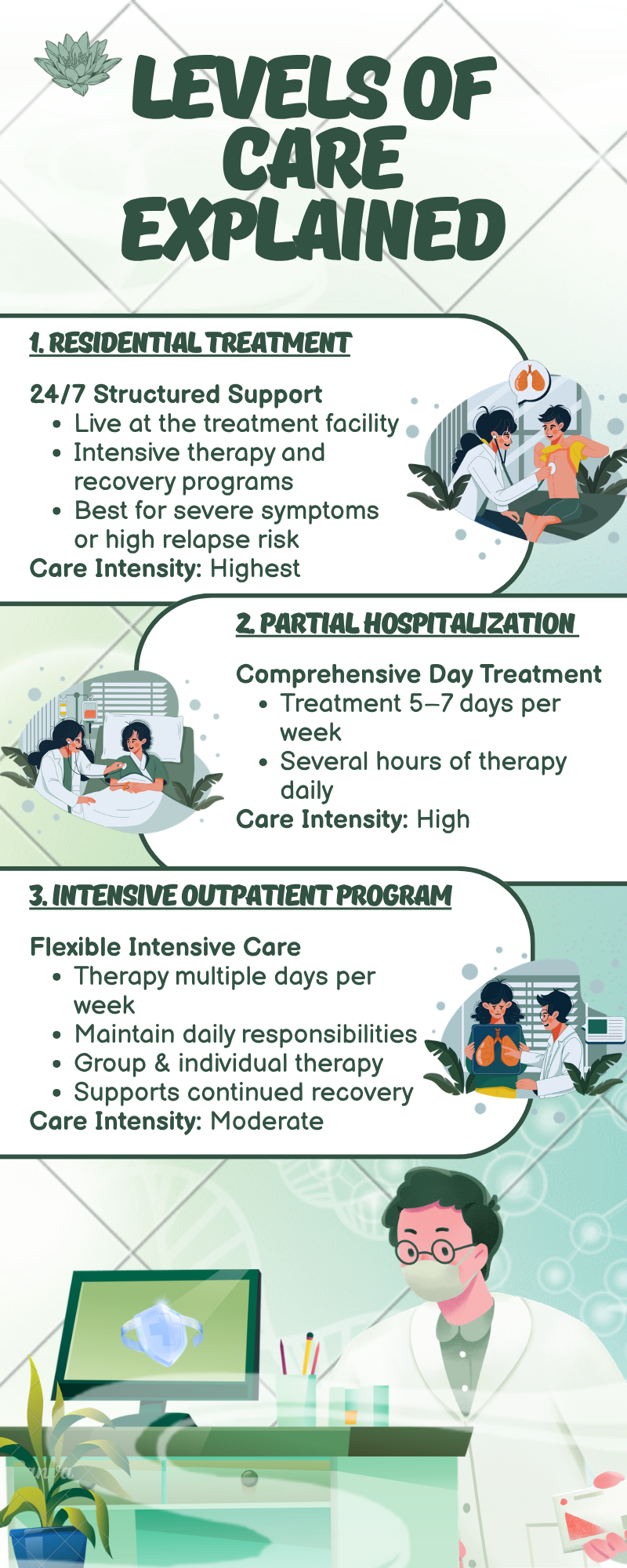
Mental health care is not all or nothing. It is not just weekly therapy on one end and a hospital stay on the other. There is a middle ground, and for many people, that middle ground changes everything.
A higher level of care NJ can give you more support without pulling your whole life apart. Think of it like using physical therapy after an injury. Sometimes rest alone is not enough. You need structure, repetition, and the right kind of help.
Treatment Level | Weekly Hours | Best Suited For | Core Components |
Intensive Outpatient (IOP) | 9–15 | Moderate to severe symptoms with work or school responsibilities | Group therapy, coping skills, psychiatric support |
Partial Hospitalization (PHP) | 25–30 | Strong daily symptoms that need close support | Daily treatment, medication review, therapy, family work |
Inpatient Care | 24/7 | Immediate safety concerns or crisis stabilization | Monitoring, safety planning, short-term intensive care |
Why Intensive Outpatient Programs in New Jersey Bridge the Gap
Sometimes people need more than one hour a week, but they do not need inpatient care. That is where intensive outpatient programs in New Jersey can help.
An IOP gives you several hours of treatment each week while you keep living at home. You can still work, care for family, or manage school, yet you get more support, more practice, and more connection. For many people, that extra structure is the missing piece.
Case Study
A well-known real example is actress and singer Demi Lovato, who has spoken openly about needing more than standard therapy during serious mental health and substance use struggles.
In her public interviews and documentary work, she explained that recovery was not about one weekly session fixing everything. It took a broader treatment plan, including therapy, medical support, structure, and ongoing care. Her story shows a simple truth: when symptoms become layered, treatment often needs to become layered too.
Sometimes healing means stepping up care, not starting over. That shift can be the turning point that helps life feel manageable again.
Alternative Modalities When the Brain Needs More Than Talk Therapy
Talk therapy can be powerful, but it does not solve everything. Some struggles live partly in the body, the nervous system, or brain chemistry. When that happens, insight alone may not move the needle much.
That is why some people do better with a mix of treatment methods. A broader plan can reach issues that talking by itself may miss.
- EMDR Therapy: Helps reduce the charge around painful memories.
- Somatic Work: Focuses on how stress and trauma show up in the body.
- Medication Support: Helps steady mood, anxiety, sleep, or attention.
- Group Therapy: Builds connection and practical coping skills.
- Skill-Based Care: Teaches grounding, boundaries, emotional control, and routines.


 Read our latest blog, “How To Choose The Right Level Of Care For Mental Health Treatment In NJ”, to learn how to find the support level that fits your needs and move forward with more clarity.