

How to Take Time Off for Mental Health Treatment in NJ (FMLA Guide)
The World Health Organization (WHO) reports that over 1 billion people suffer from mental disorders worldwide. And sadly, a huge percentage of these people don’t receive help because they don’t have viable options or aren’t allowed to step away for treatment.
But luckily, the Family Medical Leave Act (FMLA) in the US makes this treatment accessible and practical. It allows you to take time off for mental health treatment in New Jersey without risking your job, provided that you qualify for it.
This guide explains how you can take a treatment break under FMLA rules to fix your situation and live a fuller life. So no more delays, learn how to avail this leave and start treatment ASAP because all that extra burden is not worth it.
FMLA Guidelines on Mental Health Leave
Under the federal Family and Medical Leave Act (FMLA), qualified employees can take up to 12 weeks of unpaid and job-protected leave in a year for serious health conditions. Notably, the conditions qualified for this leave include mental health diagnoses such as depression, anxiety, PTSD, and bipolar disorder.
That said, here is the eligibility criteria you must meet to qualify for this job-protected time off in New Jersey:
- Your employer has 50 or more employees.
- You have maintained employment with the company for at least 12 months.
- You have completed at least 1250 work hours in the last 12 months.
If you meet these requirements, it’s great news because you can safely take time off for mental health treatment, and the employer cannot terminate or demote you for taking that leave.
How to Take Time Off for Mental Health Treatment in NJ?
The FMLA is incredible for working people because it gives them a comfortable window where they can focus on treatment without worrying about losing their jobs. Here is how you can take time off under this federal law:
Talk to the Healthcare Provider
If you meet the above-listed requirements, your employer cannot legally deny you up to 12 weeks of leave. However, this only happens if your mental health condition is serious enough to warrant full-time treatment. Since FMLA covers serious health conditions, you need a clear diagnosis from a mental health expert to make a solid case.
Put simply, if you need inpatient stay, partial hospitalization, or intensive outpatient treatment for mental health-related concerns, only then will your leave be approved. So, approach your therapist or treatment center for a professional verdict.
Fortunately, most mental health conditions, including major depressive disorder, anxiety, PTSD, OCD, eating disorders, and substance use disorders, qualify for an FMLA-backed break.
Tell the Employer and Get the Paperwork Done
Your therapist’s clear verdict on the need for treatment means the next step is to discuss it with the employer. It’s worth mentioning that you don’t have to disclose all treatment information if you aren’t comfortable. Only submitting a leave application along with a formal request like ‘I need a month off for a medical condition’ will be enough.
Note that you must give a 30-day advance notice if your treatment is planned, like an inpatient stay. But if it’s an emergency and you’re asked to get admitted ASAP, notify the employer right away so they can arrange for your absence from work.
After your leave request, the employer is required to respond within 5 business days via two key documents, which are:
- A Notice of Eligibility and Rights (Form WH-381), which tells you about your eligibility for the requested leave and other rights.
- A Designation Notice (Form WH-382). This one will be used once your leave is approved.
Besides these standard documents, an employer might also give a Medical Certification Form and ask your healthcare provider to complete it. This one’s role is to confirm that your problem is serious enough to qualify for FMLA.
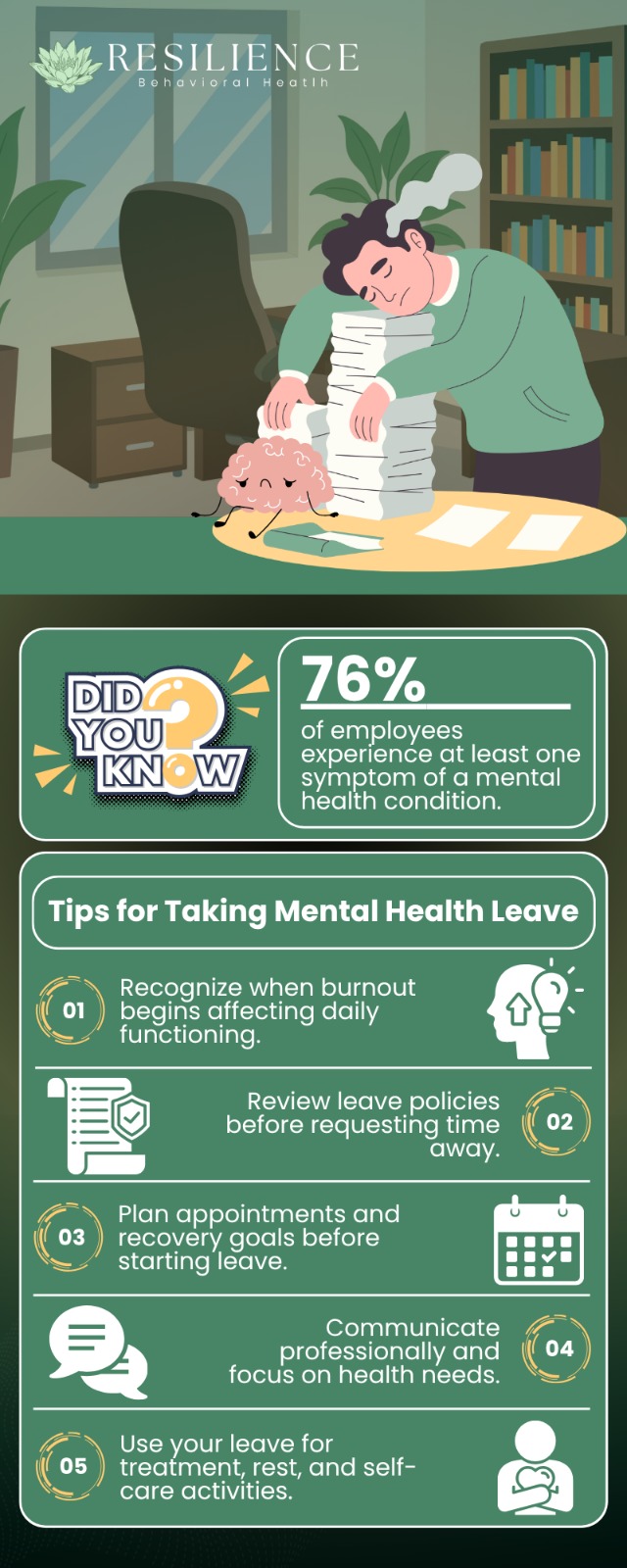
Have Your Doctor Complete the Certification
The medical certification form is to be filled out by your therapist, counselor, or psychiatrist, so take it to them. It generally requires them to enter information about your diagnosis, treatment schedule & intensity, and how your condition might affect your work.
For example, an employer might assume that you have lately had a rough week and don’t need a long break to overcome that. But if the mental health expert states in the form that it’s not simple burnout but rather something serious enough to hamper your productivity, it will support your claim.
And once the healthcare provider fills this document, return it to your HR department within 15 days, so they can process the leave.
Understand Your Leave Options
While FMLA is a standardized guideline, your exact leave duration and its schedule can differ. Here are some options you can avail for mental health treatment:
Continuous Leave: As you can tell from the same, a continuous leave means you ask for a solid block of time away. For example, if you’re starting partial hospitalization or an inpatient mental health rehab, you’ll apply for a full 12 weeks of leave because it is considered an acute crisis.
Intermittent Leave: Intermittent FMLA leave means taking time off in smaller blocks instead of a continuous duration. For example, you could have fewer work hours each week to attend therapy appointments, be present at work, and continue treatment alongside. And if you have a depressive episode, you can take a few days off. Making decisions about treatment and recovery can be supported by the evidence-based framework of motivational interviewing. Learning about employee rights and FMLA protections can make it easier to access personalized mental health support near home in Mercer County, NJ. Understanding workplace protections can make it easier to follow treatment recommendations after a psychiatric evaluation in Monmouth County, NJ. Learning about workplace protections can help individuals follow treatment recommendations after a psychiatric evaluation in Morris County, NJ. Learning about workplace protections can make it easier to follow treatment recommendations after a psychiatric evaluation in Ocean County, NJ. Learning about workplace protections can make it easier to follow treatment recommendations after a psychiatric evaluation in Ocean County, NJ.
Reduced Schedule: You can work fewer hours per day when your treatment is ongoing, but only temporarily. And while this sounds feasible, it’s the hardest to get approved for because it makes managing a replacement difficult for the employer. Since they cannot hire someone to cover for a few hours of your absence in a day, they’d prefer you take a continuous leave.
You Have Rights, Use Them
Taking time off for mental health treatment is your protected medical right. Sure, the process can be intimidating, but once you move through these steps, you’ll be away for a stress-free break. And if you feel your employer is pushing back unfairly, you can file a complaint with the US Department of Labor’s Wage and Hour Division. Also, Resilience Behavioral Health is a call away to give you a solid plan for mental health improvement: let’s discuss.


