

12-Step Facilitation And Relapse Prevention
TSF charts clear early recovery milestones through guided steps. Meanwhile, RPT anticipates cues and high-risk moments, as Pavillon models show, bolstering long-term stability.
| Therapy | Focus | Proven Outcome |
| CBT | Thought-behavior links | Lower relapse rates |
| MI | Change readiness | Higher retention |
| RPT | Trigger management | Sustained abstinence |
 If emotional instability compounds substance challenges, check our latest blog “Watchung Borderline Personality Disorder (BPD) Specialist” for targeted DBT insights.
Levels Of Holmdel Evidence-Based Substance Abuse Care
No single intensity works for every story; matching matters deeply. McGovern stresses scaling from outpatient to residential based on needs, which boosts retention and outcomes across studies.
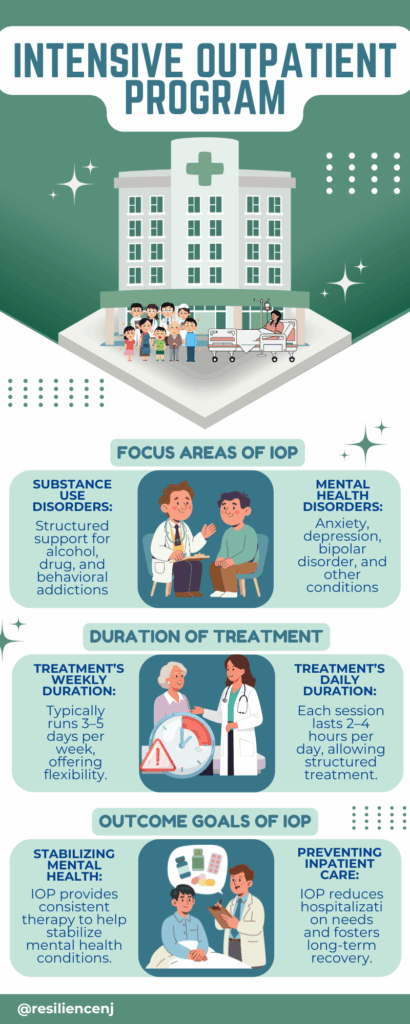
Resilience Behavioral Health delivers a smart continuum: PHP for high-structure days, IOP for weekly rigor, and outpatient for steady maintenance. This setup honors work or school while sharpening recovery skills.
PHP Vs IOP: Daily Differences
PHP mirrors inpatient depth in outpatient hours, letting you return home evenings. IOP, by contrast, packs 9-20 hours weekly—flexible enough for life, tough enough for change.
| Aspect | PHP (Partial Hospitalization Program) | IOP (Intensive Outpatient Program) |
| Daily Structure | Mirrors inpatient intensity; 5-6 hours/day, 5 days/week | 3-4 hours/session, 3-5 days/week (9-20 total hours) |
| Home Time | Return home evenings for family/practice | Full evenings/free time for work/school |
| Best For | High risk, needs rapid stabilization | Moderate needs, life balance required |
| Flexibility | Structured days, less overall freedom | More scheduling freedom, weekly commitment |
| Intensity Level | Inpatient depth, outpatient convenience | Rigorous yet manageable for daily life |
Measuring Success In Evidence-Based Programs
Abstinence sets the bar high, but fuller metrics paint the picture. McGovern tracks reductions in use alongside retention, psychiatric relief, legal wins, job stability, and family mends—standards comparable to top medical care.
Deeper engagement almost always forecasts stronger results. In Holmdel programs, weekly check-ins allow tweaks, sustaining Holmdel’s evidence-based substance abuse care through ups and inevitable dips.
What Makes Resilience Behavioral Health’s Approach Stand Out
Personalization starts with a thorough assessment, not assumptions. Resilience Behavioral Health starts with a full evaluation, then custom-blends evidence-based elements to your substance profile and any co-occurring hurdles.
Beyond that, holistic layers seal the edge: family involvement, medication oversight, vocational guidance, all echoing McGovern’s call for comprehensive, real-world support in Holmdel evidence-based substance abuse care.
Supporting Loved Ones Through Evidence-Based Recovery
Family involvement doesn’t just help—it amplifies every step. Programs equip them with boundary-setting, validation techniques, and relapse signal awareness, steering clear of common enabling traps.
When home life aligns with clinic lessons, gains stick harder. Readmission risks plummet, creating space for everyone to heal without constant crisis mode.
Lorrie’s Heroin Recovery Breakthrough
Lorrie, mid-40s from Baltimore, battled heroin for years. Life felt hopeless, no home, constant depression. Then a NIDA study changed everything. She got medication plus weekly counseling. Tried heroin once more. Nothing happened. Cravings vanished.
Nine months later, clean tests earned small rewards. Now eight years sober, she owns her apartment, car, even pots and pans. Married her partner, both recovered. “I cry tears of joy now,” she says. Evidence-based medications and therapy rebuilt her world.
Conclusion
Recovery builds on proven ground, not shaky hopes. You’ve seen how Holmdel evidence-based substance abuse care stacks therapies like CBT and MI to cut use, mend families, and steady jobs. What holds you back from that clarity today?
Resilience Behavioral Health matches science to your needs—PHP for intensity, IOP for balance. Deeper stays mean better odds, as McGovern shows. Imagine fewer crises. Stronger bonds. Real freedom.
Ready for your assessment? Call Resilience Behavioral Health now and ask which level fits your life best. Your path forward waits—just one step away.
FAQs
What Do We Mean By Evidence-Based?
Proven treatments from peer-reviewed studies that work the same way every time. They deliver real results across different places and people, not just one lucky case.
What Is The Definition Of Evidence-Based Treatment?
Science-tested methods that create steady improvements. Pavillon standards confirm they produce reliable positive changes, backed by solid research numbers.
What Are Evidence-Based Substance Use Prevention Interventions?
Smart strategies like CBT skills practice and MI conversations. These build strength early, stopping small habits before they turn into big problems.
What Is Evidence-Based Recovery?
Long-term clean living and better daily function through checked therapies. Tracked over years, just like managing diabetes or asthma for good.


